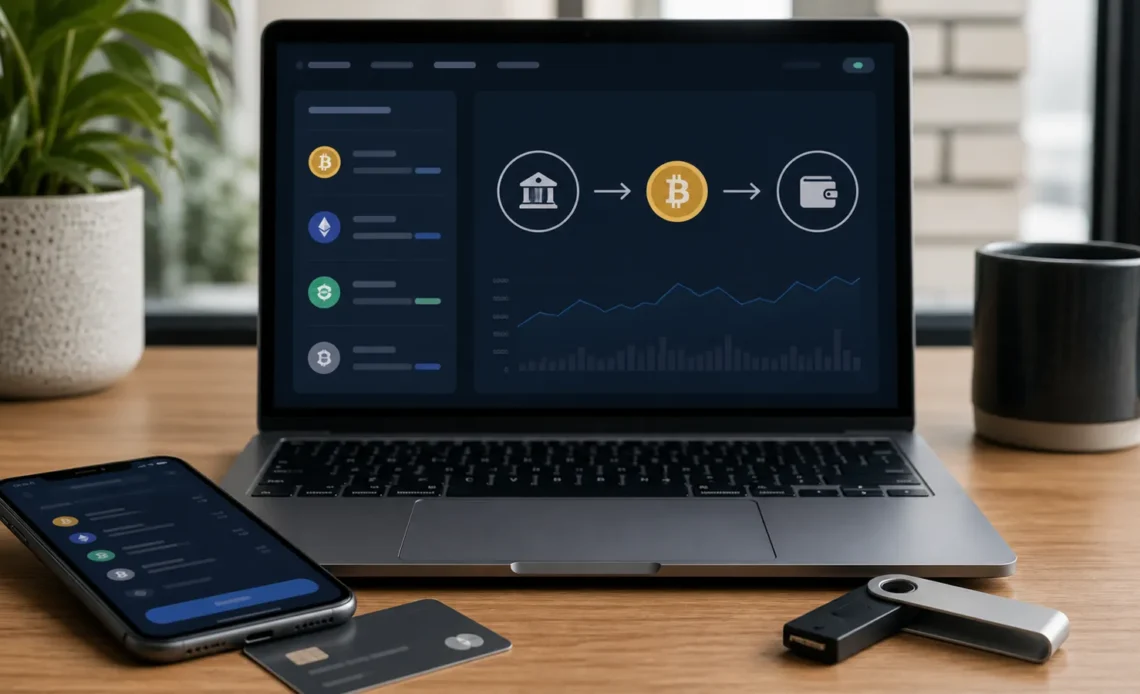
Do not follow a fixed payment-app-to-exchange recipe without checking the current rules. Account eligibility, supported assets, transfer networks, limits and fees can change by country and provider. Before sending money, compare the total cost, confirm that withdrawals are supported and decide who will control the private keys.
The safest practical approach is to choose the simplest regulated route available in your location, make a small test transfer when moving crypto to another wallet, and reject anyone who creates urgency or promises a guaranteed return. Crypto transfers are often difficult or impossible to reverse, so a mistake can become expensive very quickly.
Choose the on-ramp that fits the job
| Route | Usually useful for | Costs to check | Main limitation |
|---|---|---|---|
| Bank transfer to an exchange | Planned purchases where speed is not the only concern | Deposit fee, trading fee, spread and withdrawal fee | Bank support, settlement time and regional eligibility |
| Debit or credit card purchase | Small purchases when the provider supports the card | Card fee, provider fee, spread and cash-advance treatment | Often costs more and may be blocked by the card issuer |
| Payment app with crypto transfer | People already using an eligible account | Purchase spread, platform fee and network fee | Transfers, assets and networks may be restricted |
| Peer-to-peer marketplace | Markets with limited direct payment options | Quoted price, platform fee and payment cost | Counterparty, dispute and payment-reversal risk |
This table describes common trade-offs, not a recommendation for a particular service. Availability and legal requirements depend on where the user lives. A provider that is convenient in one country may not accept an account, bank or card in another.
Calculate the total cost, not the advertised fee
The visible transaction fee is only one part of the cost. Compare the amount paid with the amount of crypto that will actually arrive. The difference may include a trading spread, payment fee and later withdrawal or blockchain network fee.
- Deposit cost: what the bank, card issuer or payment app charges to fund the account.
- Trading fee: the provider’s stated charge for converting money into a crypto asset.
- Spread: the difference between the provider’s buy and sell prices or the wider market price shown elsewhere.
- Withdrawal fee: what the platform charges to send the asset away from the account.
- Network fee: the blockchain charge that may change with network activity.
Ask for a final preview before confirming and record the amount expected at the destination. If the service hides the exchange rate, withdrawal fee or receiving amount until after payment, comparison becomes guesswork.
Decide who should hold the crypto
Leaving crypto with a third-party custodian is simpler, but access depends on that provider’s security, solvency and account controls. Self-custody gives the owner control of the private keys, along with full responsibility for protecting them. The SEC’s investor bulletin on crypto custody explains the difference and recommends researching a custodian’s fees, security practices and complaint history.
A recovery phrase should never be typed into a website or shared with support staff. Anyone who has it can potentially control the wallet. Use strong account security, enable multifactor authentication and store recovery information away from ordinary cloud notes or messages.
Verify the asset, network and address
A supported asset is not enough. The sending service and receiving wallet must also support the same network. The official PayPal crypto transfer instructions, for example, tell users to confirm the destination address and network because an incompatible transfer can be lost. The exact options shown to an account may differ by location and eligibility.
- Open the receiving account and copy the deposit address from the correct asset and network page.
- Check the beginning and end of the pasted address instead of trusting the clipboard blindly.
- Read whether a memo, tag or other identifier is required.
- Send the smallest practical test amount first when the provider permits it.
- Wait for the test to arrive before sending the remaining amount.
Reject pressure, secrecy and guaranteed returns
The US Federal Trade Commission warns that scammers often impersonate businesses or government agencies, promise profits, or demand crypto to fix an invented problem. No legitimate helper needs a recovery phrase, remote control of a device or an extra payment to release supposed earnings.
- A stranger moves the conversation from a social network to private messaging and offers to guide the transfer.
- A site displays profits but requires another deposit, tax or verification charge before withdrawal.
- Support asks for a seed phrase, one-time code or screen-sharing access.
- The provider claims there is no risk or guarantees a return.
- The payment must be completed immediately or kept secret from a bank or family member.
Crypto assets also carry market, custody and platform risks even when no scam is involved. FINRA’s overview of crypto risks notes that protections can be limited and that theft or the failure of a service provider can affect access to assets.
Use a final five-point check
- Confirm the service is available and permitted in the relevant location.
- Compare the final receiving amount, not only the headline fee.
- Verify withdrawal support, the destination network and the address.
- Decide whether third-party custody or self-custody matches the user’s ability to protect access.
- Stop if the process depends on an unofficial middleman, urgency or a promise of profit.
A professional-looking interface is not proof that a financial platform is trustworthy. Article Thirteen’s guide to how digital platforms build trust explains which ownership, pricing, security and support signals deserve attention before a user is asked to pay.
There is no universal best on-ramp. The useful choice is the one that is legally available, clearly priced, compatible with the destination and understandable enough to use without handing control to a stranger.