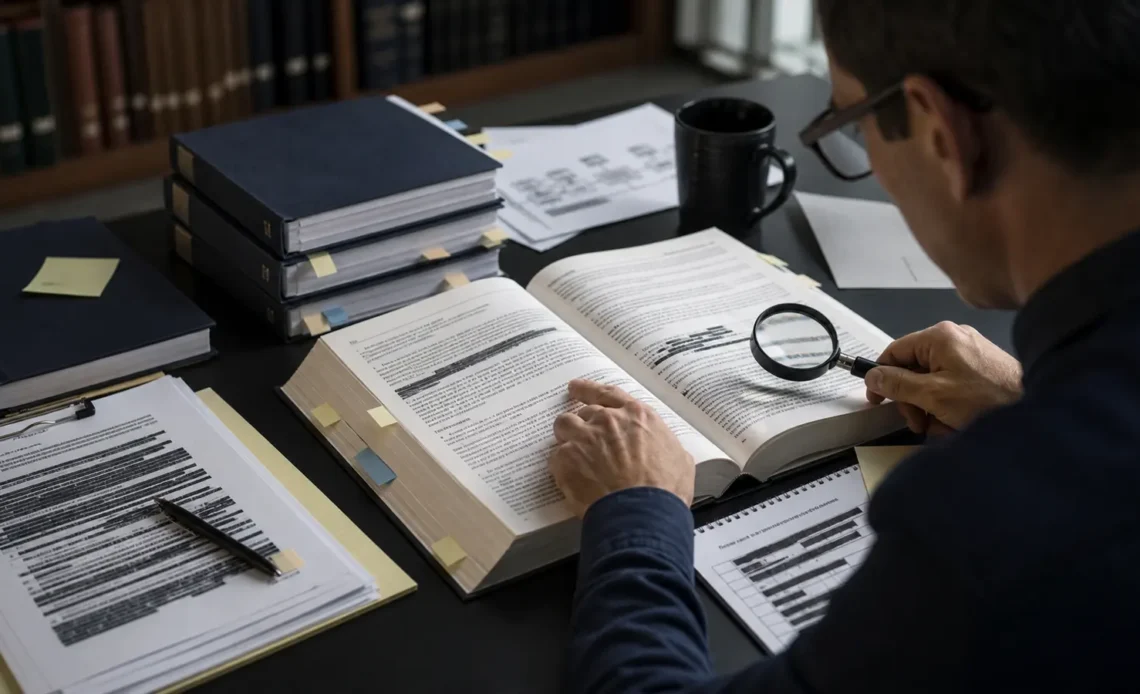
To evaluate a public investigation report, begin with the official document, identify its mandate and date, read the methodology and limitations, trace important claims to evidence, and separate the report’s language from summaries or political commentary. Record what is redacted or outside scope. A headline can tell you that a report exists; it cannot safely replace hundreds of pages, defined legal standards and footnotes.
The 2019 Mueller report is a useful case because the public discussion often compressed two volumes, different questions and redacted material into a single verdict. This guide is about reading discipline, not relitigating the politics. The same method works for regulatory reviews, inspector-general reports, corporate investigations and commissioned audits. It is not legal advice.
1. Confirm that you have the primary document
Check the publisher, title, date, version and file location. A copied PDF, screenshot or news excerpt may be incomplete. For this case, the U.S. Department of Justice hosts the official Mueller report Volume I and Volume II. The two volumes restart page numbering, so a responsible citation identifies the volume as well as the page.
Look for later versions or an official reading room. Redactions can change after litigation, declassification or privacy review. The Justice Department’s FOIA Library lists updated report files and related release records. A later file does not automatically change every conclusion, but it may provide context that the first public version did not contain.
2. Read the mandate before the findings
An investigation answers the questions it was authorized and equipped to examine. Find the appointment order, terms of reference, statute, regulation or board resolution. Note the time period, people, entities and conduct within scope. A report’s silence on an issue can mean it was outside the mandate, unsupported by available evidence or not discussed publicly. Silence is not a reliable positive finding.
Special-counsel regulations illustrate why process matters. Under 28 CFR 600.8, a special counsel provides the attorney general with a confidential report explaining prosecution or declination decisions. The route from that report to a public document involves legal and disclosure decisions. Readers should therefore distinguish the investigation’s work from the later release process.
3. Separate evidence, analysis and decision language
- Evidence: testimony, records, communications, data or physical material collected by investigators.
- Analysis: the report’s explanation of how evidence relates to a factual or legal question.
- Decision: a prosecution, declination, referral, recommendation or administrative finding under a stated standard.
- Limitation: missing records, unavailable witnesses, redactions, privilege, jurisdiction or another constraint.
Do not replace these categories with stronger everyday words. “The report examined” does not mean “the report proved.” “Insufficient evidence to establish” is not the same as proof that an event never occurred. A decision not to charge may reflect the evidence, the required legal elements, policy or another stated reason. Use the report’s exact conclusion and explain the applicable standard.
4. Trace the important sentence
When a claim could affect a person’s reputation or a business decision, follow it backwards. Find the cited page, footnote and underlying document if public. Check whether the evidence is direct, second-hand, disputed or limited. Then read the paragraphs before and after the quoted line. A sentence can be accurate and still become misleading when detached from the condition that follows it.
The National Archives’ document-analysis worksheets use a helpful sequence: identify the document, observe its parts, understand the context and use it as evidence alongside other sources. That last part matters. A primary source is close to the event, but it still has a creator, purpose, audience and limits.
5. Treat redactions and gaps honestly
A redaction means the public cannot see that material in the version being read. It does not tell the reader which side the hidden material would support. Note the stated redaction category and avoid filling the blank with a preferred theory. The same caution applies to missing messages, unavailable witnesses and unresolved factual conflicts.
Create a short uncertainty log: what is withheld, what the report says about the gap, whether a later official release exists and whether the uncertainty affects the particular conclusion you are discussing. This is more useful than scattering the word “allegedly” through an article and hoping it performs all the legal and editorial work.
6. Compare summaries by what they omit
Read official summaries, news coverage and commentary after understanding the document. Compare which volume, event and standard each source emphasizes. Check whether a headline describes a finding, a source’s characterization or a later political response. If two summaries conflict, return to the relevant section instead of averaging them into a third unsupported claim.
For organizations, decide who can approve a public statement and who verifies the underlying citation. Article Thirteen’s guide to decision-maker responsibilities helps clarify approval ownership. Its guide to building digital platform trust also explains why visible ownership and correction paths matter when publishing sensitive information.
A seven-point check before sharing a claim
- Is this the official and most relevant version of the report?
- What question was the investigation authorized to answer?
- Which volume, section and page support the claim?
- Does the sentence describe evidence, analysis, a decision or a limitation?
- Have redactions or missing evidence been represented accurately?
- Does later official material change or qualify the point?
- Could a reasonable reader mistake the wording for a stronger conclusion?
A careful reader does not need to finish every appendix before forming any view. Start with the mandate, contents, executive material and the section relevant to the claim, then follow its evidence and limits. The goal is not to make a complicated report sound simple. It is to make your statement no more certain than the document allows.