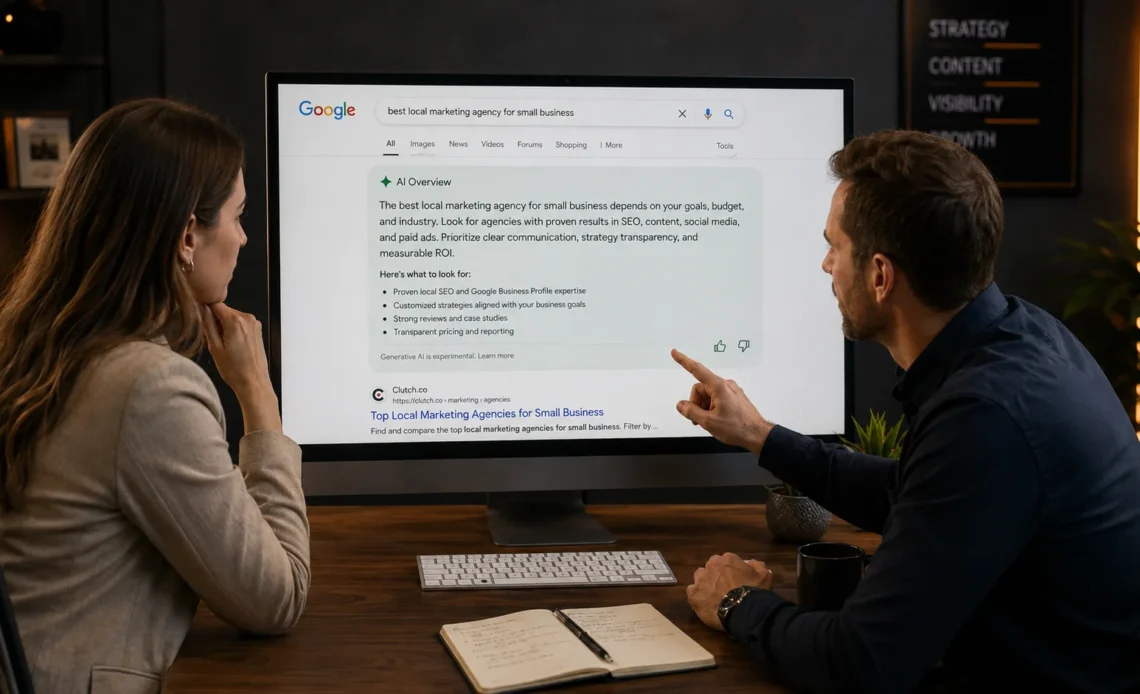
AI search has changed where people get answers, but it has not replaced SEO. Google’s current guidance is to keep the technical and content fundamentals, create genuinely useful non-commodity information, make important pages easy to find, and ignore unsupported “GEO hacks.”
Businesses should respond by improving the pages closest to revenue and trust, not by producing more generic articles for every possible prompt.
What AI Search Changes and What Stays the Same
| Area | What changed | What still matters |
|---|---|---|
| Search results | AI Overviews and AI Mode can summarize several sources before a click | Indexable pages, relevance, quality and clear answers |
| Queries | People can ask longer questions and follow-ups | Understanding the real problem behind the query |
| Content competition | Generic summaries are easier to replace | Original evidence, expertise, examples and useful decisions |
| Measurement | Visibility can occur before or without a visit | Search Console, qualified traffic, leads and sales |
| Technical work | No special AI-only markup is required | Crawlability, internal links, page experience and accurate structured data |
What Google Says Businesses Should Do in 2026
Google’s July 2026 guide to optimizing for generative AI features says traditional SEO remains relevant because AI features are rooted in Google’s core Search ranking and quality systems.
The most useful part of that guidance is its emphasis on non-commodity content. A page that repeats definitions available everywhere gives a reader little reason to choose the business. A page with original examples, first-hand experience, expert analysis, product data, a transparent method or a clear decision framework gives both readers and search systems more substance.
Google also says there is no special schema, AI text file or writing style required for its generative search features. Technical eligibility still begins with being indexed and eligible to appear with a snippet.
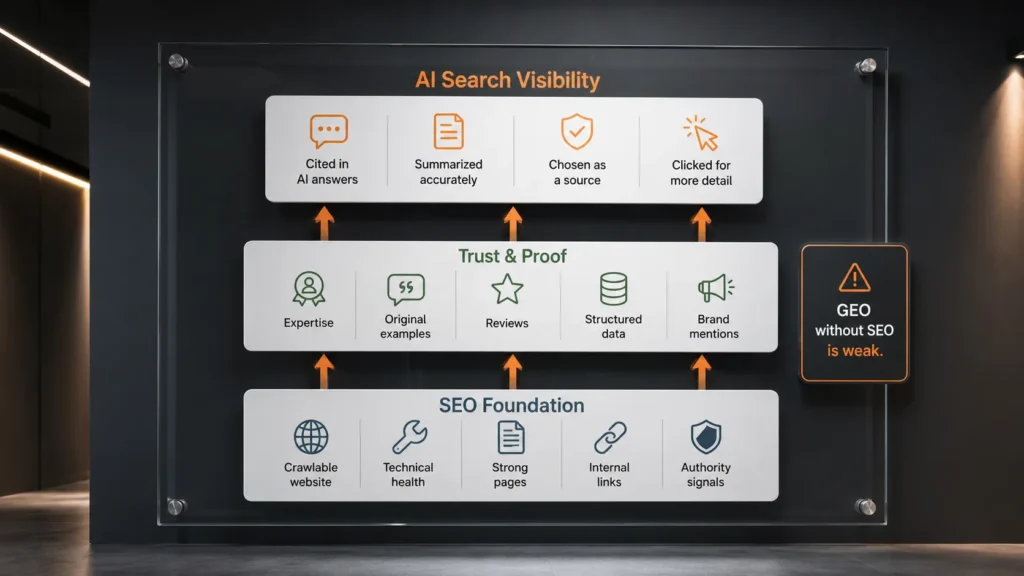
The First Six Improvements to Make
1. Fix the pages closest to a business decision
Start with service pages, product pages, comparison pages, location pages and the articles that support them. Explain who the offer is for, what problem it solves, how the process works, what evidence supports the claims and what the visitor should do next.
The order should fit the company’s stage. A local business, a growing team and a large organization need different priorities, as shown in this guide to digital marketing by business size.
2. Replace generic claims with proof
“High quality,” “innovative” and “trusted” are not evidence. Useful proof can include a documented process, named qualifications, product specifications, screenshots, before-and-after data with context, customer outcomes with permission, or a transparent explanation of how a recommendation was reached.
Do not invent testing, client results or expert experience. If the page is research-led, say so and cite the sources that support important claims.
3. Answer the decision, not only the keyword
A high-intent visitor usually needs to compare options, understand tradeoffs, estimate effort or decide what to do next. Map the page to that decision. The site’s guide to buying-intent signals and measurement explains how research and purchase behavior differ.
4. Build clear internal paths
Important pages should be reachable from relevant hubs and supporting articles. Internal links help readers continue a task and help search systems discover relationships between pages. Use descriptive anchors and add a link only where the destination genuinely helps.
5. Keep the technical foundation clean
- Allow crawling and return a successful HTTP status.
- Use a consistent canonical URL.
- Make the main answer available as readable text.
- Use structured data only when it matches visible content.
- Reduce delays and clutter that make the page difficult to use.
6. Measure business outcomes, not only rankings
Track impressions, clicks, landing pages and queries in Search Console, then connect that activity to qualified leads, sales, calls or other real outcomes. A ranking that attracts the wrong audience is not a growth strategy.
GEO and AEO Tactics You Can Ignore for Google Search
- Creating an llms.txt file to improve Google visibility: Google says it does not use these files for Search.
- Breaking every answer into tiny chunks: Google says there is no special chunking requirement.
- Adding AI-only schema: no special schema is required for AI Overviews or AI Mode.
- Rewriting copy for machines: write for the reader’s task and use a clear structure.
- Buying or manufacturing mentions: inauthentic promotion creates risk without building real authority.
A Practical 90-Day Sequence
| Period | Priority | Output |
|---|---|---|
| Days 1–30 | Technical access and money pages | Resolve indexability, page experience and weak offer explanations |
| Days 31–60 | Evidence and supporting content | Add original proof, comparisons, examples and focused support pages |
| Days 61–90 | Internal architecture and measurement | Strengthen hubs and links, then assess qualified search and conversion data |
This sequence is not a ranking guarantee. It is a way to fix the foundations before investing in more content.
Final Takeaway
AI search makes replaceable content easier to summarize, so businesses need clearer proof and more useful decisions on the page. Keep doing SEO, but direct the effort toward original value, strong commercial pages, trustworthy sourcing, crawlable internal paths and a fast, usable site. That is more durable than chasing a new acronym.