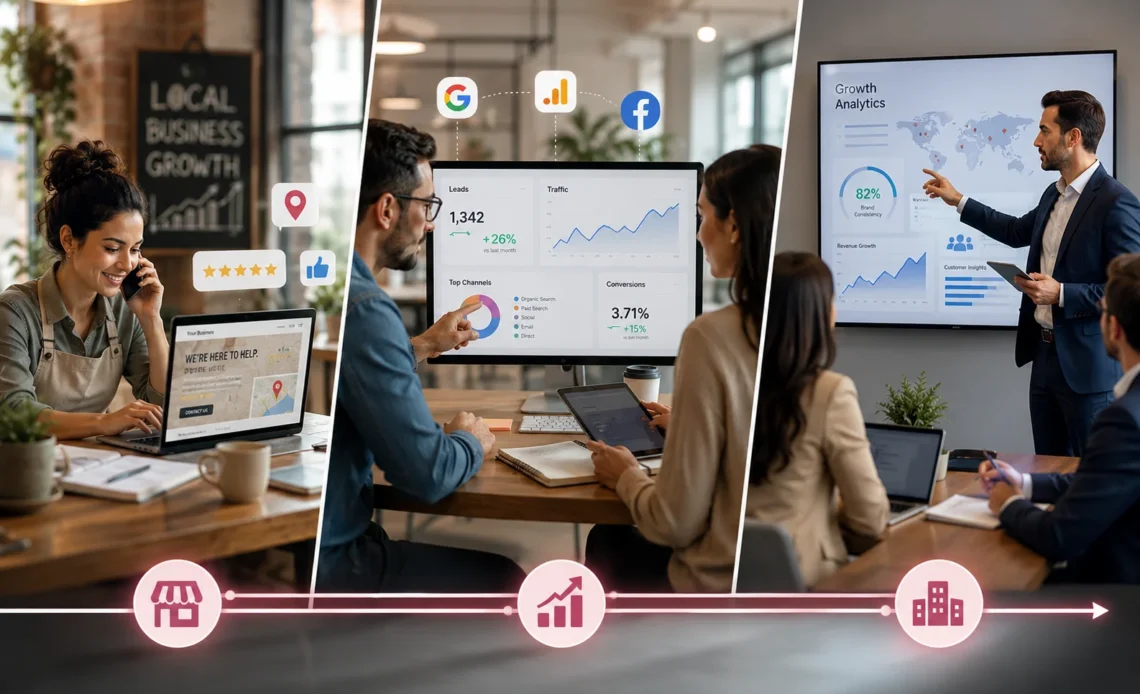
A small business owner usually wants one thing from digital marketing: make the phone ring.
A mid-sized company wants something a little different. It wants leads, but it also wants cleaner reporting, better systems, and a brand that does not look different on every platform.
A large company has another problem entirely. It may already have attention. Now it needs consistency, data, technical content, and trust across many teams, markets, and buyer types.
That is why digital marketing strategies should change with business size. Copying a bigger company too early can waste money. Staying too basic when the business has grown can quietly hold everything back.
Small Businesses Need Proof, Not Noise
Small businesses do not need to act like global brands. They need to be found, understood, and trusted.
That usually starts with the boring stuff people skip because it does not feel exciting:
- a clear website
- a simple offer
- local search visibility
- customer reviews
- useful service pages
- basic lead tracking
- one or two social channels done properly
Not glamorous. Still works.
The U.S. Small Business Administration’s marketing plan guidance is a useful reminder that small businesses should understand customers, competitors, pricing, and sales before throwing money at promotion.
For a small business, the best marketing question is not, “Are we everywhere?”
It is, “Can the right person find us and know what to do next?”
A local repair company, clinic, salon, consultant, or small online store can often grow from simple digital foundations. A messy website with weak contact details will lose leads even if the Instagram page looks nice. Painful, but true.
Growing Businesses Need Structure
Once a business starts getting steady leads, the old “try everything and see what sticks” method gets expensive.
This is where digital marketing has to grow up a little.
A medium-sized business usually needs:
- SEO planning across main pages
- landing pages for different offers
- paid ads with proper tracking
- email follow-up
- better content planning
- clearer brand messaging
- reporting that shows what is working
This stage is also when teams start asking better questions.
Which channel brings the best leads?
Which pages convert?
Which campaigns only look busy?
Which keywords show buying intent, not just traffic?
That last one matters. Traffic is nice, but traffic that never converts is mostly decoration.
Think with Google’s data and measurement resources show how modern marketing depends on cleaner measurement and better use of customer signals. For growing businesses, this is where guessing starts to get replaced by evidence.
Search visibility is changing too. AI-generated results affect how customers discover and compare companies, so growing teams should understand how AI search changes SEO for businesses.
More attention is good. Better handling of that attention is what turns it into growth.
Large Companies Need Scale and Trust
Large businesses usually have the budget. That does not mean marketing becomes easier.
In fact, bigger companies often have bigger confusion.
One team runs paid ads. Another handles SEO. Someone else manages email. A regional team changes the messaging. Sales has its own deck. Suddenly the customer is seeing five versions of the same company.
That is not a strategy. That is a group project with too many tabs open.
Large businesses need digital marketing that can scale without feeling cold or disconnected. This is where customer data, personalization, automation, and technical content become more important.
McKinsey notes that good personalization can lift revenue and marketing ROI when it is done well. The important words are “done well.” Personalization is not just adding a first name to an email. Everyone has seen that trick.
Real personalization means giving different buyers the information they need at the stage they are in.
That matters even more in B2B marketing. Gartner reports that many B2B buyers prefer a rep-free sales experience, which means they want to research and compare before speaking to sales.
So content has to do more work.
Technical Companies Need Better Educational Content
Some products cannot be sold with a catchy slogan.
If the buyer is looking at a complex industrial, scientific, or infrastructure solution, they need clarity. They need application details. They need to understand the risk, use case, and technical fit.
This is where large-company digital marketing becomes less about hype and more about education.
Xylem is a good example. A page about ultrapure water for microelectronics is not written for casual browsing. It is aimed at a specific buyer who already has a technical problem and needs a trusted solution.
That kind of content does not behave like a normal blog post. It supports search visibility, sales conversations, product education, and buyer confidence at the same time.
Small businesses can learn from this, even if they are not selling complex water systems. The lesson is simple: the more specific the buyer’s problem, the more specific the content should be.
What Changes at Each Stage?
| Business size | Main goal | Best digital focus |
| Small business | Get found and trusted | Website, local SEO, reviews, simple content |
| Growing business | Build repeatable leads | SEO, paid ads, email, tracking, landing pages |
| Large business | Scale trust and consistency | Data, personalization, technical content, brand systems |
The tools overlap. The priorities do not.
A small business may need one strong service page before it needs a full content calendar. A growing company may need better tracking before increasing ad spend. A large company may need to fix message consistency before launching another campaign.
The Best Strategy Fits the Business Stage
Digital marketing is not about using every channel. It is about using the right channel for the current stage of the business.
Small businesses should focus on proof and clarity.
Growing businesses should build repeatable systems.
Large businesses should connect data, content, and brand trust across the whole customer journey.
The mistake is trying to look bigger instead of becoming better.
A business does not need louder marketing. It needs marketing that matches where it is now and helps it move one step forward.
That sounds less exciting than a viral campaign. It also works more often.
For campaigns that include a physical brand touchpoint, use this checklist for choosing useful promotional products.