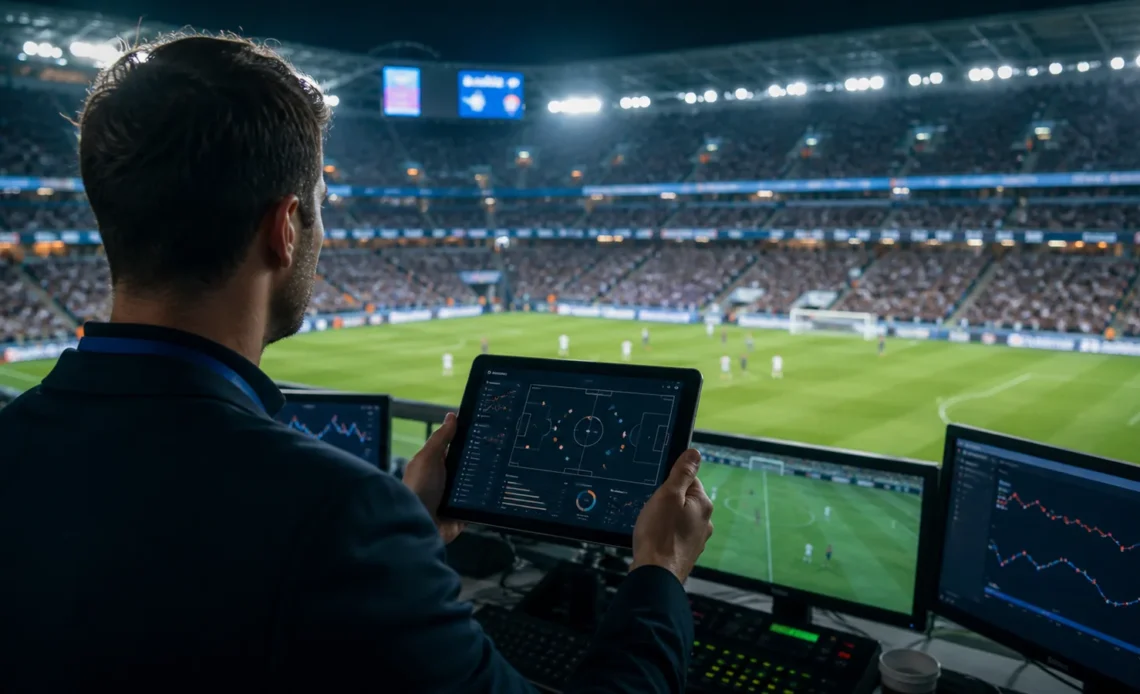
A live score looks simple because the complicated part is hidden. Before a goal, pitch, shot or substitution appears in an app, someone or something must capture the event, attach the right time and player, validate it, distribute it and update the interface. Real-time sports data is a chain, not a magic feed.
That chain now powers broadcasts, team analysis, stadium screens, fantasy products and second-screen fan experiences. Speed matters, but a fast wrong update is still wrong. Product teams have to balance latency, accuracy, context and the rights attached to the data.
Sports data begins with several kinds of observation
Some events are logged by trained operators. Others come from optical camera systems, radar or wearable devices. FIFA describes electronic performance and tracking systems as camera-based or wearable technologies used to control and improve player and team performance. Different sports combine those methods in different ways.
- Event data records actions such as a pass, foul, pitch, substitution or score.
- Tracking data estimates the position and movement of players, officials or the ball over time.
- Biometric or workload data may come from approved wearables used in controlled team environments.
- Context data adds competition, venue, lineup, clock and game-state information needed to interpret an event.
The source determines what the data can honestly claim. A manually tagged event may explain what happened. A tracking system can add where and how quickly. Neither automatically explains why a player made the decision.
The feed needs timestamps, validation and a clear source
A useful live feed does more than send a number. It identifies the event, time, participant, source and correction state. Systems also need rules for duplicates, clock differences and updates that arrive out of order. Without those basics, two screens can show conflicting versions of the same moment.
Corrections are normal in complex data systems. The product should update the record clearly rather than pretending the first value was perfect. Historical reports, notifications and graphics may all depend on that corrected event, so one quiet change can travel a long way.
Low latency is useful only when the product explains uncertainty
Latency is the time between the event and its appearance in the product. Capture, network transmission, validation, processing and device updates each add delay. A broadcast graphic may favor a verified update, while an internal coaching tool may use faster raw information with different warnings and access controls.
Designers should avoid presenting an estimate as a settled fact. Use labels or interface states for provisional data, corrections and unavailable measurements. A spinning icon is not an explanation, especially when the number changes a moment later.
Tracking creates new ways to explain a game
Major League Baseball’s Statcast glossary describes a system that combines tracking technologies to measure pitches, batted balls, players and bats. The value for fans is not the existence of more numbers. It is the ability to explain a play with details that a box score could not show on its own.
- A broadcast can add one meaningful measure to a replay instead of covering the screen with a dashboard.
- A team app can connect a live event to a player profile, season context or explanatory clip.
- A venue screen can show timely information that helps spectators understand a review or substitution.
- An accessible interface can pair visual updates with clear text or audio descriptions.
More data can still produce a worse fan experience
A product fails when it treats every available measure as equally important. Fans need context, not a spreadsheet poured over the match. Choose statistics that answer the question raised by the moment and make the definition available without interrupting the action.
Historical comparisons also need care. Tracking methods, rules and available measurements change. A model trained on one competition or era may not transfer cleanly to another. If the comparison has a limitation, say so before the chart becomes a confident but shaky conclusion.
Rights, privacy and access belong in the product plan
Live data can involve league rights, team systems, athlete information and vendor contracts. Product teams should define who owns each feed, who may redistribute it, how long it is retained and whether personal or sensitive information is included. A technically accessible feed is not automatically free to reuse.
Access controls matter as well. Public fan data, internal performance data and health-related information should not be treated as one interchangeable pool. The interface may look similar while the permissions and risks are very different.
A practical checklist for a live sports feature
- Name the source and the event or measurement being captured.
- Set an acceptable latency and accuracy threshold for the use case.
- Design a visible correction path for provisional or changed data.
- Explain unfamiliar measures in plain language.
- Confirm distribution rights, retention rules and access levels.
- Test the feature during poor connectivity and a genuinely busy event.
Article Thirteen’s guide to building a business data analytics stack covers the broader question of how collection, storage and analysis tools fit together. In sport, the same architecture has a less forgiving clock. The data has to arrive while the moment still matters.