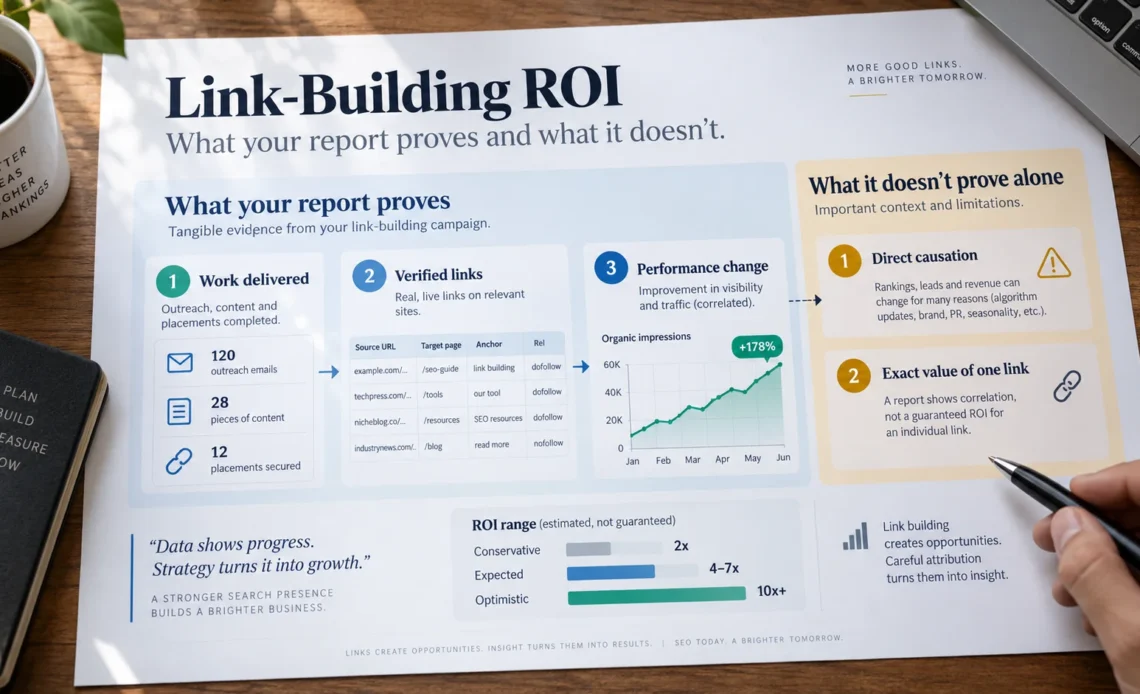
A link-building report can prove that work was delivered. It cannot, by itself, prove that the work caused better rankings, leads or revenue. To judge link-building ROI properly, separate four questions: What work was performed? Which links can be verified? What changed in search or referral performance? What did the business gain?
That distinction prevents two expensive mistakes. The first is paying for activity that looks impressive but produces little value. The second is abandoning useful work because its effect cannot be read from one metric or one reporting month. A credible assessment connects delivery, outcomes and cost while being honest about what cannot be attributed to an individual backlink.
A link-building ROI report needs four layers
Start by keeping evidence at the correct level. A live link is evidence of delivery. A ranking movement is an SEO outcome. A qualified enquiry is a business outcome. They may be related, but they are not interchangeable.
| Measurement layer | Useful evidence | What it can establish | What it cannot establish alone |
|---|---|---|---|
| Work performed | Prospects reviewed, outreach sent, replies and placements agreed | Whether the agreed process took place | Whether any useful link was delivered |
| Verified delivery | Live source URL, correct target, anchor text, link attribute and placement context | Whether a reported placement exists in the stated form | Whether it improved search performance |
| Search and referral effects | Landing-page visibility, organic visits, referral sessions and assisted conversions | Whether relevant performance changed after the work | Whether links were the only cause |
| Business result | Qualified leads, sales, contribution margin, customer value and campaign cost | Whether the activity supported a commercially useful outcome | The exact value of one link without a sound attribution method |
A report that jumps from “20 links built” to “campaign successful” skips the two layers that matter most to the person paying the bill.
Verify what was actually delivered first
Every reported placement should have a source URL that opens and a link to the intended page. Check the anchor text, whether the link is followed, nofollowed, sponsored or marked as user-generated content, and whether the surrounding page is relevant. A link hidden in a broken template, an unrelated page or a repeated sitewide block is not equivalent to an editorial mention inside useful content.
- Open the exact source page, not just the website homepage.
- Confirm that the link points to the agreed canonical destination.
- Record the visible anchor and the link’s
relattribute. - Check whether the placement is editorial, paid, user-generated or sitewide.
- Record pages that are blocked or unreadable as unverified, not automatically lost.
Google’s Search Console Links report is useful, but Google describes it as a sample rather than a complete inventory. It may also show a link that has since been removed. That makes Search Console helpful for discovery and pattern checking, but insufficient as the only delivery record.
When a report contains many exact source URLs, WebDiagnosis can reduce the first-pass checking work by reading public pages and returning page-level evidence for review. It does not place links, bypass logins or prove that a placement improved rankings. Pages it cannot read should remain unknown until someone checks them through an appropriate method.
The danger of judging prospects by a headline metric is visible in a 1,001-row backlink-prospect study. Only 788 rows were readable and 37 were classified as followed-link opportunities. None of the 285 DR50+ rows appeared among those 37. This was one supplied list, not a universal benchmark, but it shows why domain rating cannot replace exact-page verification.
A live link can still be a poor business asset
Once delivery is verified, judge whether the placement makes sense for the page and audience. Relevance is not a category label alone. Ask whether a reasonable reader of the source page could benefit from following the link, whether the destination answers the implied question, and whether the placement adds information rather than interrupting the text.
Authority metrics can help sort a large list, but they are third-party estimates. Treat them as screening signals alongside topical fit, real page quality, placement type, geographic relevance and signs of manipulation. Article Thirteen’s discussion of adapting link-building strategy to the industry is especially relevant here because the same source will not carry the same practical value for every business.
Payment also changes the assessment. Google’s spam policies on links identify buying or selling links for ranking purposes and other manipulative placements as link spam. Its guidance on qualifying outbound links recommends rel="sponsored" for advertisements and paid placements, and rel="ugc" for links in user-generated content. A campaign should not count a policy risk as a high-value asset simply because the URL is live.
Measure performance without pretending it proves causation
Measure the pages the campaign was meant to support, not only the domain as a whole. Record their baseline visibility, organic visits, relevant conversions and revenue or lead quality before the work begins. Then compare the same measures over an agreed observation period.
Look for a coherent pattern rather than one exciting chart. Did the linked landing page gain impressions for relevant queries? Did organic visits reach that page or related pages? Did referral visitors engage or convert? Did the change survive beyond a short fluctuation?
Even a coherent pattern needs cautious language. Content updates, internal links, technical fixes, seasonality, competitor changes and search-system updates can move performance during the same period. As Article Thirteen’s analysis of AI search and SEO measurement explains, business outcomes deserve more attention than rankings alone, but the supporting evidence still has to be genuine.
A sound report can say that performance improved after a campaign and explain why links may have contributed. It should not claim that every extra visit or sale came from those links unless the attribution method supports that conclusion.
Calculate commercial return as a range
The basic arithmetic is straightforward:
ROI = (attributed contribution minus campaign cost) ÷ campaign cost × 100
The difficult part is “attributed contribution.” Gross revenue can exaggerate the return because it ignores the cost of delivering the product or service. Using contribution after variable costs gives a more useful business view. The campaign cost should include agency or contractor fees, placements, software and meaningful internal time.
Do not force a precise number when attribution is uncertain. Build a conservative, expected and optimistic range. For example, the conservative case might include only directly recorded referral conversions. The expected case may include a defensible share of improved organic conversions on supported pages. The optimistic case can model a larger contribution, but its assumptions must remain visible.
- Direct value: conversions recorded from referral visits.
- Supported organic value: a cautious portion of improved conversions from the targeted search pages.
- Future value: recurring contribution expected from durable visibility, discounted for uncertainty.
- Total cost: fees, placements, tools and internal labour used by the campaign.
A range is less tidy than a single percentage, but it is more useful for a real decision. It shows how much of the apparent return depends on assumptions.
Decide whether to continue, correct or stop
Link-building ROI is not only a retrospective score. It should guide the next allocation of time and money.
- Continue when delivery is verifiable, placements are relevant, supported pages are improving and the commercial range is acceptable.
- Correct when the work is real but targeting, destination pages, anchors, reporting or conversion tracking are weak.
- Pause when too many placements are missing, unverifiable, irrelevant or policy-sensitive, or when the supplier cannot explain discrepancies.
- Stop when repeated corrections fail and the expected return remains below a more credible use of the same budget.
The observation window should fit the business and campaign. A slow sales cycle needs different reporting from an ecommerce transaction. A new page also has a different baseline from an established page with stable demand. Changing the success measure after results arrive turns analysis into storytelling.
What a credible monthly report should show
As a business grows, marketing reporting should become clearer, not merely larger. Article Thirteen’s guide to digital marketing at different stages of growth makes the same broader point: reporting should reveal what is working and which campaigns only look busy.
- A delivery log with every agreed source URL, target, anchor, placement date and link attribute.
- A status check that separates live, removed, changed, redirected, unreadable and not-yet-verified placements.
- Quality notes covering relevance, placement context, duplication and any payment or disclosure requirement.
- Performance for the pages the campaign intended to support, compared with the agreed baseline.
- Referral, assisted and organic conversions shown separately rather than rolled into one success number.
- Campaign cost, commercial scenarios, assumptions, unresolved questions and the next decision.
The most trustworthy report may contain more “unknown” labels than a glossy one. That is not weakness. It shows where evidence ends and inference begins.
The standard is evidence that supports a decision
A link count is an operational total, not a return on investment. Start by verifying delivery, assess whether each placement is relevant and defensible, measure changes on the intended pages, then connect those changes to commercial value using transparent ranges.
If the report cannot show that chain, ask for the missing evidence before buying more activity. If it can show the chain while acknowledging attribution limits, you have something far more useful than a bigger backlink number: a basis for the next business decision.
Disclosure
WebDiagnosis was created by Hasnain Mehdi, an Article Thirteen contributor. Article Thirteen independently selected the topic, analysis and conclusions. No ranking or ROI outcome is claimed for the tool.