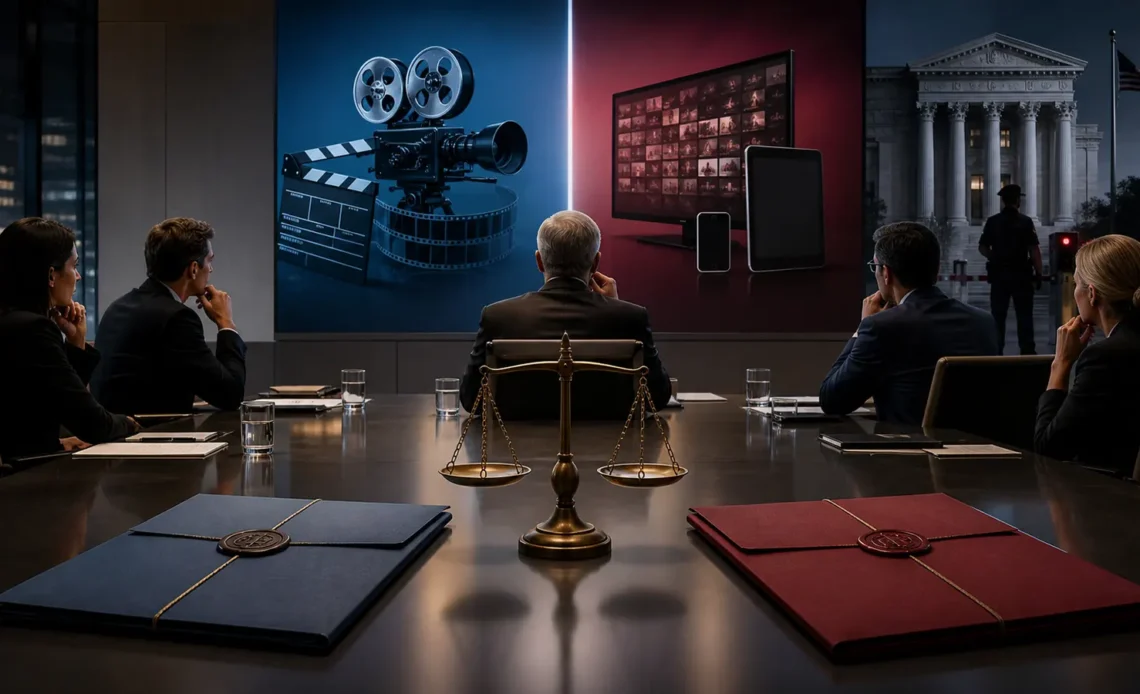
The highest acquisition offer is not automatically the best offer. Boards and shareholders have to compare what is being bought, how payment is structured, whether financing is committed, which fees protect the seller, how long approval may take and what happens if the deal fails. The 2025 to 2026 contest for Warner Bros. Discovery is a useful case because Netflix and Paramount offered different structures, and the apparent winner still faced a long path between signing and closing.
As of August 16, 2026, Paramount had a definitive agreement to acquire Warner Bros. Discovery for $31 per share in cash, and WBD shareholders had approved it. The companies had received many regulatory clearances, but the transaction had not closed and remained affected by US state antitrust litigation. That status matters. “Netflix dropped out,” “Paramount signed a deal” and “Paramount owns WBD” are three different statements. Only the first two were established.
What happened, in the correct order
- Netflix had an agreement covering specified Warner Bros. assets and declined to raise its offer after WBD’s board treated Paramount’s revised proposal as superior. Netflix confirmed that decision on February 26, 2026.
- Paramount and WBD signed a definitive merger agreement on February 27. Paramount’s official transaction announcement set the price at $31 per WBD share in cash.
- WBD shareholders approved the transaction on April 23, 2026.
- By July 22, Paramount said authorities representing 65 jurisdictions had cleared the transaction or chosen not to challenge it, according to its European Commission clearance update.
- A group of US states continued to challenge the merger, and the companies agreed to delay closing while the case continued, as reported by Associated Press on July 24, 2026. The deal therefore remained pending rather than completed.
Compare the terms on the same basis
| Decision factor | What to compare | Why headlines mislead |
|---|---|---|
| Price | Per-share value, equity value and enterprise value | A headline may include assumed debt while another reports only cash paid for shares |
| Deal scope | Whole company, selected assets, spin-off or retained liabilities | Two offers can value different packages |
| Payment form | Cash, buyer shares, seller shares or a mix | Quoted value can move with markets or depend on a later separation |
| Financing | Committed equity, debt, conditions and refinancing needs | A high offer is weaker if funding can disappear |
| Failure protection | Break fee, reverse termination fee and ticking fee | These terms divide the cost of delay or failure |
| Approval risk | Shareholder vote, competition review, foreign investment review and litigation | Signing does not transfer ownership |
| Integration burden | Debt, systems, brands, people, contracts and promised savings | The winning bid can destroy value after closing |
Price needs a denominator
Paramount’s announcement described the transaction as $31 per WBD share and about $110 billion in enterprise value. These figures are not alternatives. Per-share price describes consideration for equity. Equity value multiplies the relevant shares by the offer. Enterprise value adds debt and adjusts for cash and other items to represent the value of the operating business being acquired. A report that calls the transaction an $81 billion or $110 billion deal may be using a different measure. Readers should check the label before treating the numbers as a contradiction.
Scope creates another denominator problem. Netflix’s earlier agreement did not have the same structure as Paramount’s whole-company acquisition. A board cannot compare headline values without adjusting for assets retained, liabilities transferred, spin-off value, tax effects and execution steps. A smaller number for a smaller or cleaner package may deliver more usable value.
Certainty has a price
A seller may prefer a lower headline if the buyer has committed financing, fewer conditions and a clearer approval path. It may demand more when the buyer needs heavy borrowing, complex asset sales or a long regulatory process. Break fees compensate one party under specified failures. Reverse termination fees can protect the seller if the buyer cannot close. Ticking fees increase consideration after a deadline and make delay more expensive. None guarantees completion; each changes who carries the risk.
The Paramount agreement included a ticking fee after September 30, 2026 and a large regulatory termination fee. Those protections are economically meaningful because delay can distract management, unsettle staff, pause investment and weaken customer relationships. A board should value them alongside the offer price rather than treating contract protections as legal wallpaper.
Regulatory clearance is a process, not a badge
Competition authorities examine whether a deal may reduce competition, raise prices, lower quality or slow innovation. The FTC’s merger-review explainer shows that an initial waiting period can expire, an agency can request more information, remedies can be negotiated or a transaction can be challenged. Approval in one jurisdiction does not resolve every other jurisdiction or private and state litigation.
- Which markets and customer groups could lose a meaningful alternative?
- Could the combined company control important content, distribution or supplier access?
- Are promised efficiencies specific, verifiable and likely to reach customers?
- Would a remedy preserve competition in practice, or only move an asset on paper?
- How long can both companies operate under deal restrictions before value starts leaking?
The board’s decision is not the finish line
Directors compare price, certainty, duties to shareholders and the evidence available at the time. Article Thirteen’s guide to business decision-maker responsibilities helps separate the board’s approval role from management’s execution role and specialist advice. After signing, management still has to protect current operations while preparing a lawful integration.
The integration case should identify system consolidation, debt service, content spending, brand decisions, talent retention and customer effects. Savings that depend on removing duplicated work may also remove expertise or service capacity. Revenue synergy deserves the same skepticism: putting two catalogues in one company does not guarantee more attention, lower churn or better advertising.
A practical acquisition-offer checklist
- Normalize each offer to the same assets, liabilities, shares and valuation date.
- Separate cash certainty from stock or spin-off value that can change.
- Read the financing commitments and conditions, not only the buyer’s confidence statement.
- Model the cost and probability of regulatory delay, litigation and required remedies.
- Compare break fees and timing protections under several failure scenarios.
- Test integration assumptions against named systems, teams, contracts and budgets.
- Update the assessment after every filing, vote, clearance and court order.
If the transaction closes, communication will become part of the value case. Customers need to know which services, prices, accounts, privacy terms and support routes change. Article Thirteen’s guide to digital platform trust explains why ownership and support clarity matter when a company asks users to continue through a major transition.
The useful lesson from the bidding contest
Netflix’s decision not to match was a capital-allocation decision, not proof that Warner Bros. lacked value. Paramount’s higher cash offer won the signed agreement, but the agreement still faced timing, litigation and integration risk. That is the point of the case. A disciplined buyer needs a walk-away price. A disciplined seller needs to value certainty. Everyone else needs to stop writing “completed” when the document still says “subject to closing conditions.”