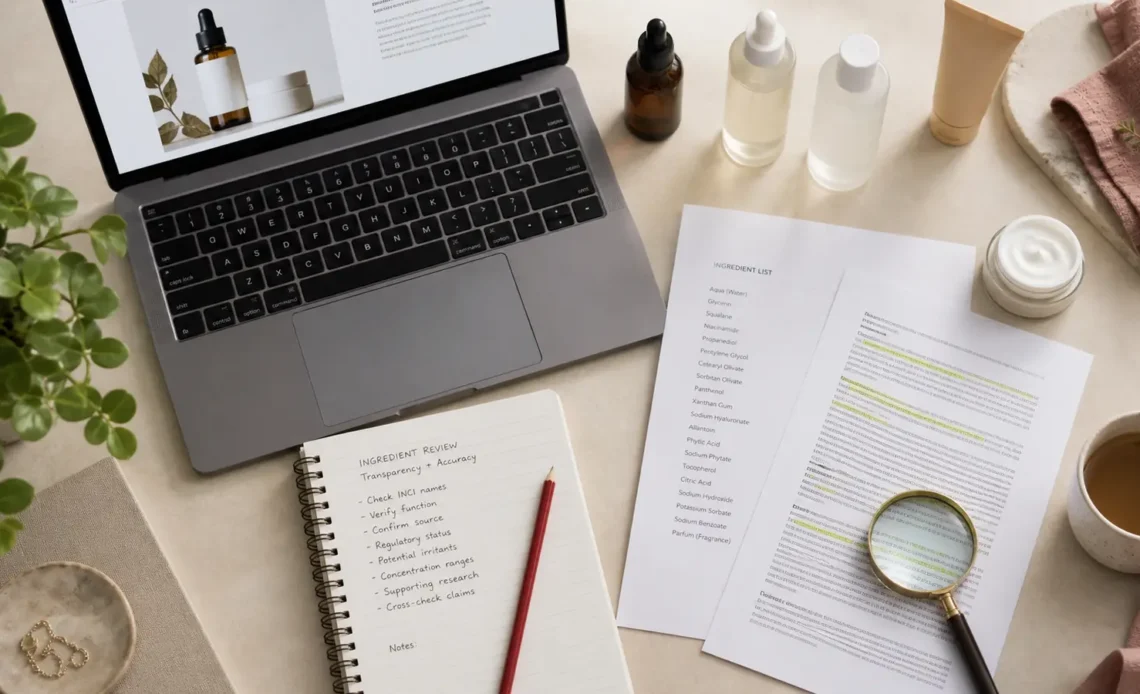
An ingredient name is not proof of a product result. “Contains salicylic acid” describes a formula. “Treats acne” makes a much stronger claim about what the finished product does. Before skincare copy goes live, the brand should identify the exact promise a reader will take from the words, images and surrounding page, then confirm that the evidence supports that promise.
This matters because cosmetic language can cross into drug or health-claim territory. In the United States, the FDA explains that cosmetic labeling must be truthful and not misleading, and that claims about treating or preventing disease or affecting the body’s structure or function can make a product a drug under the law. Requirements differ across markets, so local regulatory review is necessary before publication.
Name the claim before polishing the sentence
Copy teams often begin with an ingredient sheet and work outward. A safer process starts with the consumer takeaway. Highlight every statement that describes a result, safety, speed, comparison or level of proof. Then include claims that appear indirectly through a heading, photograph, testimonial or product name.
| Example wording | What a reader may understand | What the editor needs |
|---|---|---|
| “Contains glycolic acid” | The ingredient is present in the finished formula | A verified, current formula and accurate ingredient label |
| “Helps skin feel smoother” | Users can expect a noticeable cosmetic benefit | Product-relevant evidence, clear conditions and no guarantee |
| “Treats acne or inflammation” | The product treats a condition or changes body function | Regulatory classification and substantiation review before use |
| “Clinically proven” | Strong testing proves the exact advertised result | A suitable finished-product study that supports the precise claim |
| “Safe for every skin type” | No meaningful user is likely to experience a problem | Very strong support or narrower, carefully qualified wording |
The table is not a list of pre-approved phrases. It shows why changing one verb can change the evidence and regulatory questions. A long scientific ingredient name is not a permission slip.
Make sure the evidence matches the finished product
A supplier paper may explain how an ingredient behaves under particular conditions. It does not automatically prove that a cleanser, serum or cream delivers the same outcome. Concentration, formulation, contact time, packaging and the group studied can all affect whether research applies to the advertised product.
The FTC’s health-products advertising guidance says marketers are responsible for express and implied claims and should have adequate substantiation before an advertisement runs. It also warns that a valid study can still be inadequate when it does not support the specific claim made in the ad.
- Is the evidence about the same finished product or only one ingredient?
- Were the amount, use pattern and duration similar to the advertised instructions?
- Did the study measure the result stated in the copy?
- Does the wording reflect limitations, mixed results and the population studied?
- Has someone qualified to assess the research checked the interpretation?
Write the information a buyer can actually use
Useful skincare copy is not a parade of benefits. It tells the reader what the product is, how it fits into a routine, what the directions require and what limitations matter. When relevant and supported, explain texture, fragrance, packaging, frequency of use and whether the formula contains ingredients some buyers prefer to avoid.
Keep instructions separate from promises. “Apply to damp skin and rinse” is a direction. “Reveals flawless skin” is an outcome claim, and an absolute one at that. Clear copy can still sound appealing without pretending that every bathroom is a controlled laboratory.
- Describe: product type, size, texture and verified formulation facts.
- Explain: intended place in a routine and the label directions.
- Qualify: who the claim applies to, how it was measured and meaningful limits.
- Separate: general ingredient education from evidence about this product.
- Escalate: disease, safety, structure-function and strong efficacy claims for specialist review.
Review images, reviews and comparisons too
A page can imply a claim without stating it in the body copy. Before-and-after photographs, arrows pointing to “problem” areas, dramatic timelines and selected customer reviews can create a stronger promise than the headline. The FTC notes in its advertising guidance for small businesses that testimonials do not replace the evidence needed for an objective health or safety claim.
Check comparison language with the same care. “Gentler,” “faster” or “better absorbed” needs a clear comparator and support for that comparison. If the evidence only establishes an ingredient fact, keep the copy at the ingredient-fact level.
Give every claim an owner and a source
- Create a claim list covering the label, product page, advertisements, images, reviews and influencer brief.
- Record the evidence, market, version and expiry or review date for each objective claim.
- Ask regulatory and subject specialists to review claims that cross into health, treatment or safety.
- Lock the approved wording so later design edits do not strengthen it accidentally.
- Recheck the page when the formula, supplier evidence, instructions or target country changes.
This discipline supports more than compliance. Readers are more likely to trust a brand that explains ownership, limitations and support clearly. Article Thirteen’s guide to digital platform trust shows how transparent pricing, support and evidence work together before a customer is asked to pay.
Good skincare marketing reduces the distance between what the evidence shows and what the customer hears. It can be confident, specific and engaging without turning one ingredient into a miracle or one testimonial into a clinical trial.