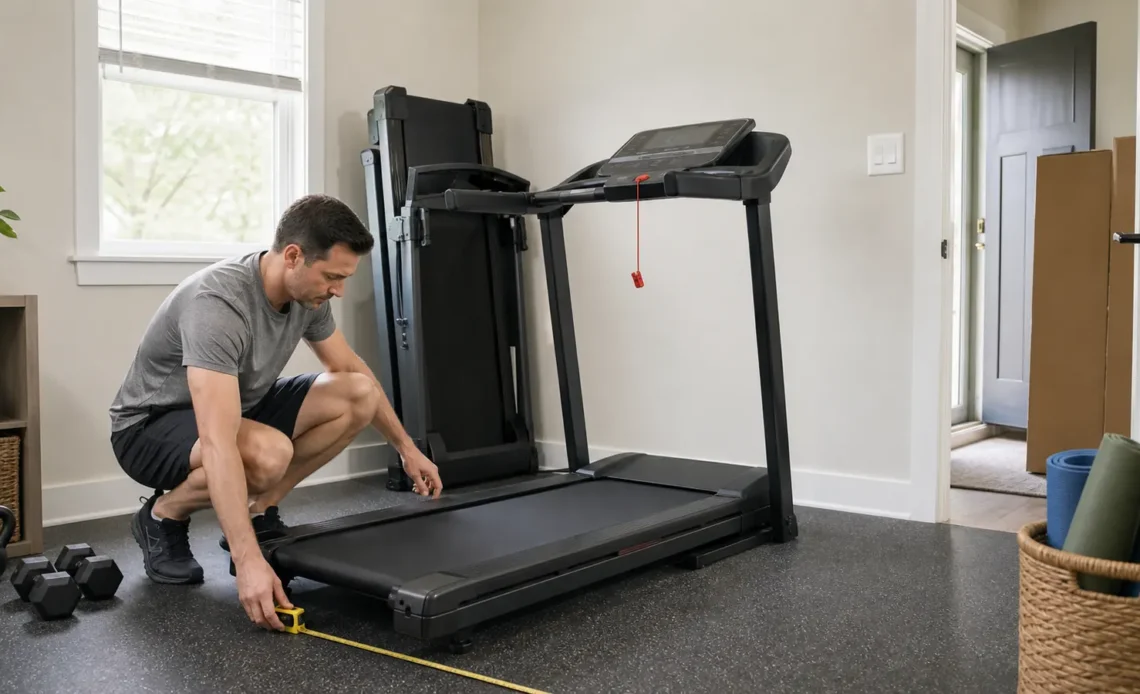
Choose a home treadmill in this order: measure the room and delivery route, define who will use it and how, test the belt and controls at the intended pace, confirm the user-weight limit and power requirements, then compare safety features, warranty, returns and ongoing costs. Extra screens and workout subscriptions come last. A treadmill that does not fit the room or your stride is just an unusually expensive clothes rack.
This is a buying framework, not a prescription for exercise. Anyone with chest symptoms, fainting, significant balance problems, a recent injury or a medical condition that affects exercise should ask a qualified healthcare professional what activity and equipment are appropriate.
Measure the real space, not the catalogue photo
- Operating footprint: record the machine’s full length and width when open, plus safe clearance around it.
- Ceiling clearance: add the deck height, the tallest user’s height and the extra rise at maximum incline.
- Delivery route: measure doors, hallways, stairs, turns and lifts, and compare them with the boxed dimensions and weight.
- Floor and power: confirm that the location, floor and electrical supply meet the manufacturer’s installation instructions.
- Storage movement: if it folds, test whether the intended user can safely raise, lower and move it. Folding does not make a heavy machine magically polite.
Noise and vibration matter in apartments and shared homes. Listen at walking and running speeds, not only while the belt idles in a showroom. Ask whether a mat is permitted and useful for that floor. Do not use an extension lead, modify a plug or improvise installation when the manual requires a particular outlet or circuit; follow the manufacturer and a qualified electrician where needed.
Match the machine to the hardest regular use
| Expected use | Prioritize | Check in person |
|---|---|---|
| Walking | Low starting speed, stable hand supports, simple controls and comfortable deck | Step-on height, noise and how quickly the belt responds |
| Jogging or running | Adequate belt area for the user’s stride, stable frame and suitable continuous use rating | Foot placement, side-rail clearance and control access at pace |
| Intervals or incline work | Responsive speed and incline controls plus an easy emergency stop | Transition smoothness and whether the display remains readable |
| Several household users | Capacity for the heaviest user, adjustable controls and durable service terms | Setup time between users and profile or subscription restrictions |
| Walking while working | Low noise, practical control access and a stated use case that matches the product | Stability with the intended desk and safe cable placement |
Do not select motor power, belt size or top speed from a universal online number. Manufacturers describe motors and duty cycles differently, and a comfortable stride varies by user. Compare the stated rating, warranty and intended use, then test the exact model at the pace you expect to use. A high top speed has little value if the belt feels cramped long before you reach it.
Treat safety features as purchase requirements
Look for an emergency stop that is easy to reach, a safety key or clip, stable side rails and controls that do not require a complicated menu during movement. Check how the belt stops and restarts. The U.S. Consumer Product Safety Commission’s treadmill standards material highlights entrapment concerns around moving belts and rear rollers.
Keep children and pets away from an operating treadmill and from the area behind it. Remove or secure the safety key and follow the manual’s lockout or unplugging instructions when the machine is not in use. Before buying used or new equipment, search the CPSC recall database or the equivalent authority in your country using the exact brand and model.
Calculate the full ownership cost
The purchase price may exclude delivery, assembly, upstairs installation, removal of packaging, a floor mat, subscription features and future servicing. Ask which console functions work without a paid account or internet connection. If the screen fails or a subscription ends, the basic speed, incline and safety controls should still behave as the product documentation promises.
Read the warranty by component and labour, not only by its longest number. Check who provides service in your area, whether transport is covered and which storage conditions or maintenance failures can void coverage. The Federal Trade Commission’s warranty guidance explains the difference between written warranty coverage and optional service contracts for U.S. buyers.
Use the return window before it disappears
- Confirm whether the return period starts at purchase, delivery or completed installation.
- Ask who pays collection, disassembly, restocking and return freight.
- Test every control, speed range and incline function allowed by your exercise plan.
- Check belt tracking, unexpected noises, stability and whether the safety stop works as documented.
- Save the invoice, serial number, manual, warranty terms and photos of any delivery damage.
When buying online, verify the seller, delivery terms and support route before entering payment details. Article Thirteen’s guide to what customers need from an online store provides a practical trust checklist that also applies to bulky fitness equipment.
The shortest sensible buying decision
Buy the simplest treadmill that safely supports the intended users, regular workout and available space. Test it, understand the service path and keep optional entertainment separate from essential controls. The right machine makes starting easier. The wrong one makes an excellent reminder that measurements are cheaper than returns.
