
India’s position in the global AI economy has drawn attention following its recent AI summit, but attention and achievement are not the same. The Indian AI market is expanding, and AI startups in India are increasingly visible across fintech, SaaS, and enterprise automation.
Yet visibility does not automatically translate into technical depth or global competitiveness. The broader AI ecosystem in India still faces infrastructure gaps, compute dependence, and uneven execution standards.
In the artificial intelligence sector in India, optimism is plentiful; operational consistency is less so. Investors evaluating the India AI economy are not asking how large the stage was, they are asking whether the code runs, the models scale, and the businesses generate sustainable returns.
In emerging tech ecosystems, ambition often arrives faster than infrastructure, a pattern not unique to India.

India’s recent AI summit generated headlines and optimism. It also triggered practical questions about execution quality, demonstration maturity, and ecosystem readiness. In capital markets, perception creates momentum, but sustained performance creates valuation. The difference matters.
India AI Economy by the Numbers
According to projections from NASSCOM, PwC India, and McKinsey & Company, the Indian AI market is projected to grow significantly by 2030, with artificial intelligence contributing to productivity across multiple sectors.
Key structural indicators include:
- India’s IT services industry projected to cross $300 billion in revenue
- Over 100,000 DPIIT-recognized startups, with thousands building AI-enabled solutions
- Rapid enterprise AI adoption in banking, telecom, logistics, and e-commerce
- One of the world’s largest annual STEM graduate pipelines
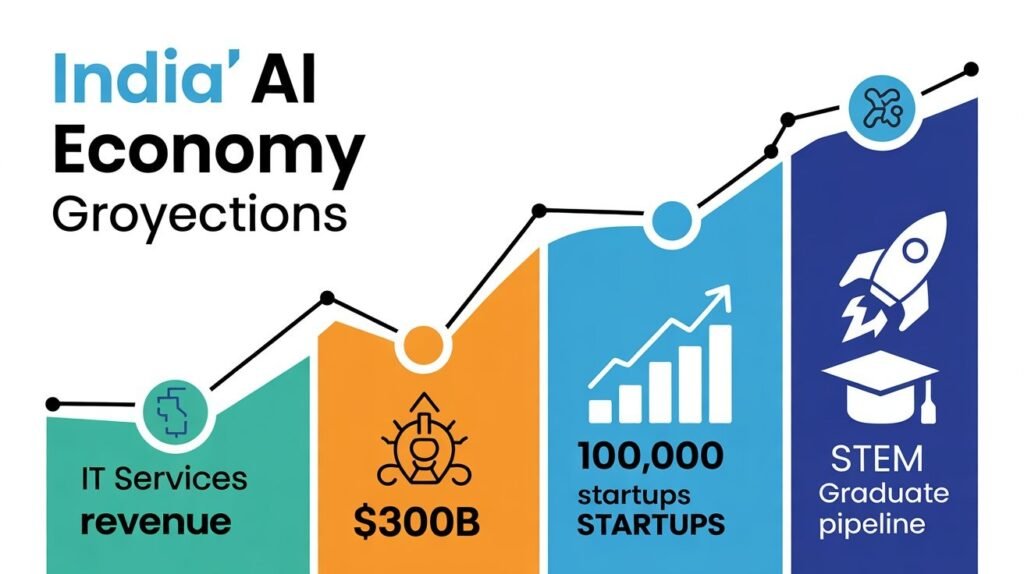
Scale remains one of the strongest advantages within the AI industry in India. With population-level demand, AI products can be tested and iterated quickly across large user bases. However, scale without execution discipline can amplify weaknesses just as quickly as strengths.
Scale is a strategic advantage, but scale alone does not guarantee technical excellence.
What the AI Summit Represented
The AI summit aimed to:
- Position India as a competitive AI ecosystem
- Strengthen startup-investor collaboration
- Showcase applied AI use cases in healthcare, agriculture, and fintech
Large technology events serve coordination and signaling functions. They influence how global investors perceive the Indian tech ecosystem.
However, some participants questioned logistical execution and the maturity of certain demonstrations. These concerns remain anecdotal rather than institutional conclusions, but they highlight a core issue: in the AI ecosystem in India, credibility compounds slowly and erodes quickly.
In artificial intelligence markets, applause is temporary. Infrastructure is permanent.
Policy and Infrastructure Context
The India AI economy operates alongside national initiatives including:
- India Semiconductor Mission
- Digital India infrastructure programs
- National Strategy for Artificial Intelligence (NITI Aayog)
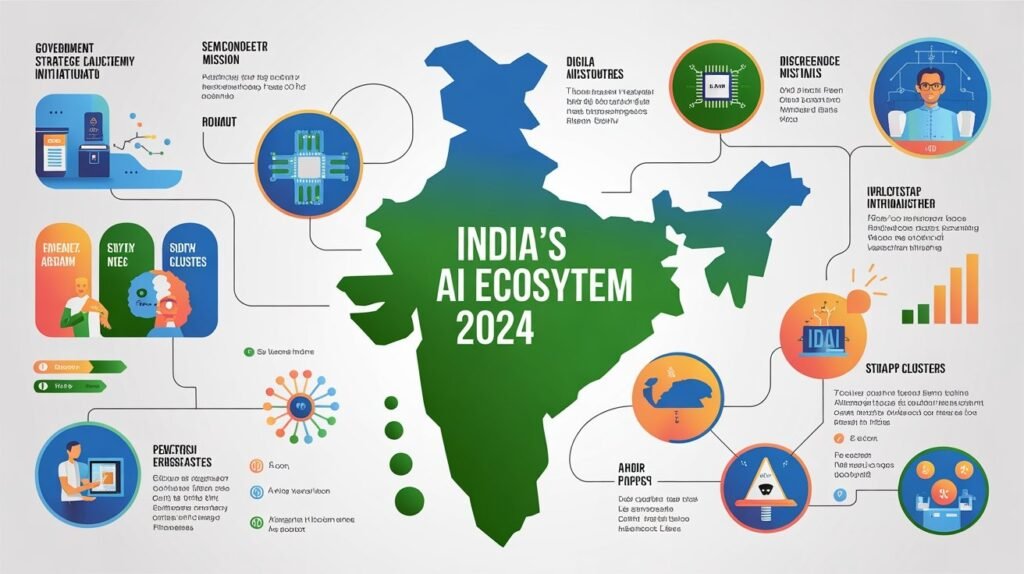
Policy support can accelerate growth in the artificial intelligence sector in India. Government-backed programs provide funding pathways and regulatory clarity. However, global competitiveness ultimately depends on alignment between public policy and private-sector execution.
AI ecosystems thrive when:
- Technical transparency remains central
- Founder credibility is prioritized
- Market signals guide capital allocation
If presentation begins to outweigh engineering depth, investor narratives shift from innovation to optics.
Where the India AI Economy Is Competitive
Applied and Commercial AI
The AI startups in India are currently stronger in applied AI than in foundational model development.
Commercially viable solutions are emerging in:
- Financial fraud detection
- Healthcare diagnostics support
- Regional language AI tools
- SaaS automation platforms
- Supply chain optimization

Applied AI aligns well with India’s services-driven economic structure. It generates revenue faster than frontier research and fits enterprise integration cycles within the Indian AI market.
Cost-Efficient Engineering Talent
India produces one of the largest pools of engineers globally. Lower operational costs compared to Western markets allow AI startups in India to experiment with reduced burn rates.
Cost efficiency provides a runway. But runway only matters if product-market fit and technical depth follow.
Enterprise Integration
AI adoption is embedded in:
- Customer service automation
- Risk modeling systems
- Data analytics infrastructure
Domestic enterprise demand strengthens the commercial layer of the AI ecosystem in India. Early signals of scalable growth include AI SaaS expansion, fraud analytics deployment, and regional language adoption.
Where Structural Gaps Remain
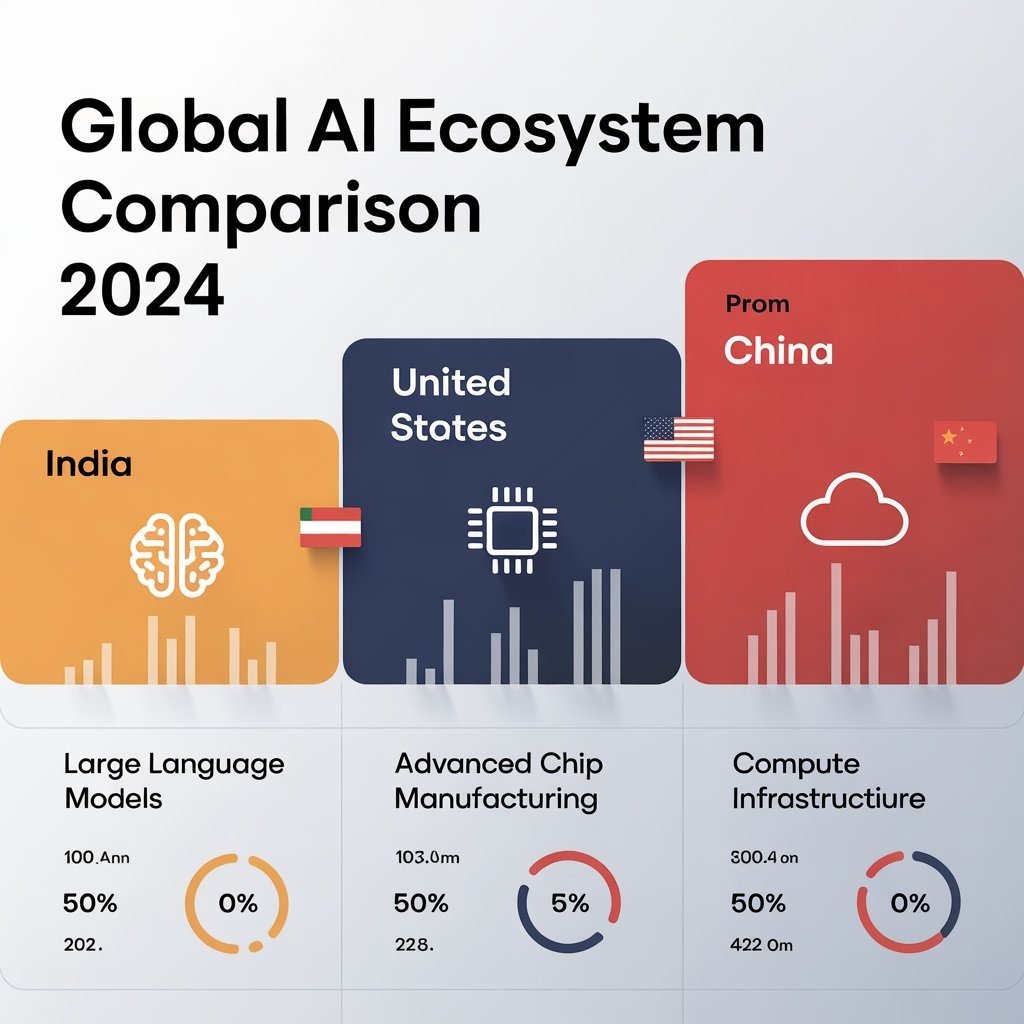
Despite progress, the India AI economy lags behind leaders like the United States and China in:
- Foundational large language model ownership
- Advanced AI chip manufacturing
- Independent large-scale compute infrastructure

Much of the Indian AI market still depends on global cloud providers such as AWS, Microsoft Azure, and Google Cloud. Deep frontier research investment remains comparatively limited.
The ecosystem is evolving, but evolution requires sustained capital allocation toward compute infrastructure, semiconductor capability, and research depth.
Software ingenuity fills gaps, but hardware sovereignty remains limited.
India vs United States vs China: AI Ecosystem Comparison
Artificial intelligence sector overview (2026 estimates):
China
- Largest AI R&D investment: ~$30B annually (state + private)
- Advanced semiconductor production: >70% domestic high-end chips for AI
- AI talent pool: ~1.5M engineers with AI specialization
- Large-scale AI deployments in finance, logistics, smart cities
- Government-backed ecosystem ensures centralized coordination
United States
- AI R&D investment: ~$25B annually (private + federal)
- Leading frontier AI research and proprietary large language models
- Advanced semiconductor design but relies partially on global manufacturing
- AI startups in US: ~15,000 active with high global funding
- Private-sector innovation drives applied and foundational AI
India
- AI startups in India: 8,000+ AI-enabled solutions, mostly applied AI
- AI workforce: ~500,000 engineers; large-scale STEM graduate pipeline
- AI infrastructure largely dependent on global cloud providers (AWS, Azure, Google Cloud)
- Enterprise adoption: SaaS tools, fintech solutions, regional language AI
- Foundational model development and domestic AI chip production are limited
Investment Signals to Monitor
Rather than focusing solely on summit optics, investors should track measurable indicators within the Indian AI market:
- Growth in AI startup funding rounds
- Infrastructure investment announcements
- Export-oriented AI product launches
- Strategic international technology partnerships
These metrics reflect operational strength more reliably than event headlines.
If capital flow, infrastructure buildout, and export growth accelerate, the India AI economy strengthens structurally. If they stagnate, summit enthusiasm will be remembered primarily as narrative momentum rather than transformation.
Final Assessment of the India AI Economy

India is not yet a dominant AI superpower.
It is also not an ecosystem built purely on hype.
The India AI economy demonstrates:
- Strong commercial AI momentum
- Significant enterprise integration
- An expanding startup base
- A large technical workforce
It also faces:
- Infrastructure dependence
- Limited frontier model ownership
- Execution consistency challenges
In artificial intelligence markets, sustained execution defines leadership. The transition from summit visibility to measurable performance will determine whether the AI ecosystem in India evolves into a durable global competitor, or remains an ambitious market still building its foundations.
In the end, code stability matters more than conference lighting.