
California, March 13, 2026, Nvidia ($NVDA), one of the world’s most influential semiconductor companies, saw its stock decline today by 1.53%, prompting investors to search for answers behind the sudden dip.
The company sits at the center of the artificial intelligence boom, supplying GPUs that power generative AI systems, data centers, and machine learning infrastructure worldwide. Because Nvidia plays such a critical role in the global technology ecosystem, even small stock fluctuations can trigger widespread market reactions.
To understand why Nvidia stock is falling today, it is important to examine several interconnected factors:
- Geopolitical tensions
- AI market expectations
- Semiconductor supply chain dependencies
- Investor sentiment
- Energy costs affecting chip manufacturing
Why Geopolitical Tensions Affect Nvidia Stock
One of the most significant factors influencing Nvidia’s stock today is rising geopolitical uncertainty, particularly tensions involving the United States and Iran.
Conflicts or instability in key global regions can disrupt shipping routes, energy markets, and technology supply chains. These disruptions are especially important for semiconductor companies like Nvidia that rely on complex global manufacturing and logistics networks.
Recent concerns surrounding the Strait of Hormuz, one of the world’s most important oil shipping routes, have already raised questions about global economic stability and production costs. Our analysis on
Strait of Hormuz risks and global inflation explores how these tensions could affect global markets:
Similarly, energy price spikes tied to instability in the region could ripple through technology supply chains and increase manufacturing costs. We also examined this scenario in detail here:
The semiconductor industry alone is currently valued at over $600 billion, and analysts project it could surpass $1 trillion by 2030, according to industry forecasts. Any disruption affecting global trade or energy markets can therefore impact companies at the heart of this ecosystem.
For a deeper analysis of geopolitical risks affecting technology companies, see our pillar coverage:
How the US-Iran Conflict Could Disrupt the $3 Trillion Global Tech Industry.
AI Demand and Investor Expectations – NVIDA Stock

Another major factor behind Nvidia’s volatility is the massive surge in AI adoption across industries.
Nvidia GPUs power many of the world’s most advanced AI systems, including generative AI models, machine learning frameworks, and large-scale cloud infrastructure.
Companies developing AI technologies rely heavily on Nvidia hardware. For example, OpenAI’s rapid expansion highlights the scale of demand. According to recent estimates, the company has reached more than $25 billion in annualized revenue, a sign of explosive growth in AI services.
However, when expectations grow extremely high, even small signs of slower growth, supply constraints, or cautious forecasts can trigger short-term stock corrections.
This dynamic explains why Nvidia often experiences significant price swings despite strong long-term fundamentals.
Supply Chain Dependencies and Global Risks
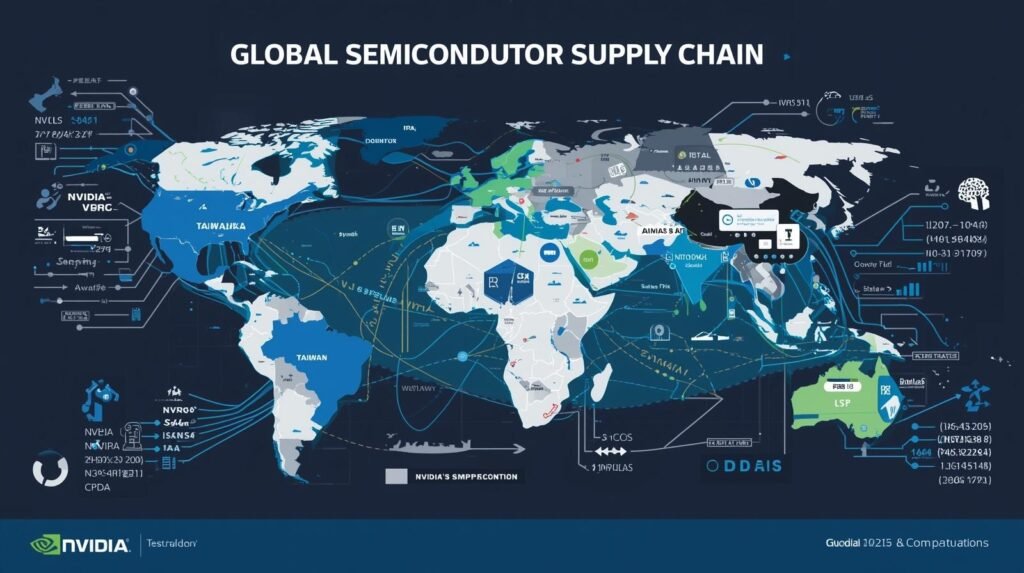
Nvidia does not manufacture its own chips. Instead, it relies on a highly specialized international semiconductor supply chain.
Key dependencies include:
- Advanced chip fabrication in Taiwan, particularly through companies like TSMC
- Semiconductor manufacturing infrastructure in South Korea
- Complex global logistics for transporting finished components
Because of this structure, Nvidia’s production capacity can be influenced by:
- Geopolitical tensions
- Shipping disruptions4
- Natural disasters
- Manufacturing bottlenecks.
This vulnerability is not unique to Nvidia. Many industries rely on similarly complex supply chains. For example, global automakers depend heavily on Chinese manufacturing components, demonstrating how localized disruptions can affect global markets.
Investor Sentiment and Market Volatility
Tech stocks driven by innovation often experience stronger volatility than traditional industries.
Nvidia is particularly sensitive to investor sentiment, because it represents one of the most prominent companies tied to the AI revolution.
During periods of optimism, Nvidia’s stock can surge rapidly. But when concerns arise about macroeconomic risks, geopolitical tensions, or supply constraints, investors sometimes take profits quickly.
Some analysts still remain highly bullish on Nvidia’s long-term outlook. In fact, one veteran analyst recently suggested that investors looking to benefit from the AI boom should focus on leading chip companies such as Nvidia and Broadcom.
You can read that analysis here:
Energy Prices and Technology Costs
Another overlooked factor affecting semiconductor companies is energy costs.
Chip manufacturing is extremely energy intensive. Fabrication plants require massive amounts of electricity to power precision manufacturing equipment and cooling systems.
If global energy prices rise due to geopolitical tensions or supply disruptions, semiconductor production costs can increase significantly.
Because Nvidia depends on external manufacturers, higher electricity costs can indirectly affect:
- production expenses
- chip pricing
- profit margins
- investor sentiment
This connection between geopolitics, energy markets, and semiconductor manufacturing explains why tensions in oil-producing regions sometimes influence technology stocks.
What Investors Should Consider
While short-term volatility can be unsettling, investors should evaluate Nvidia within a broader technological and economic context.
Key considerations include:
Focus on long-term AI growth
Artificial intelligence adoption continues expanding across healthcare, finance, defense, and enterprise automation.
Monitor geopolitical developments
Supply chain disruptions and global conflicts can create temporary market instability.
Diversify investment exposure
Balancing portfolios across multiple sectors can reduce risk during periods of volatility.
.Businesses exploring AI adoption are also rapidly deploying automation technologies powered by advanced AI systems. Our guide to the Top AI Agent Tools for Enterprise Automation highlights emerging technologies transforming corporate operations:
Why is Nvidia stock down today?
Nvidia’s stock decline is linked to a mix of geopolitical tensions, investor expectations about AI growth, supply chain risks, and broader market sentiment.
How does the US-Iran conflict affect Nvidia?
Geopolitical tensions can disrupt global supply chains and energy markets, increasing production costs and creating volatility for semiconductor companies.
Should I invest in Nvidia now?
Many analysts view Nvidia as a long-term AI leader, but investors should remain aware of short-term risks such as geopolitical instability and market volatility.
How big is the semiconductor market Nvidia operates in?
The semiconductor industry is valued at more than $600 billion today and could exceed $1 trillion by 2030, according to industry forecasts.
Conclusion
Nvidia’s stock decline today reflects a combination of geopolitical tensions, investor expectations surrounding AI growth, semiconductor supply chain vulnerabilities, and energy market uncertainty.
Despite these short-term pressures, Nvidia remains one of the most strategically important companies in the global technology ecosystem. As artificial intelligence continues reshaping industries, the demand for high-performance computing hardware is likely to remain strong.
For investors, understanding the broader forces influencing Nvidia’s stock can help provide clarity during periods of market volatility.