


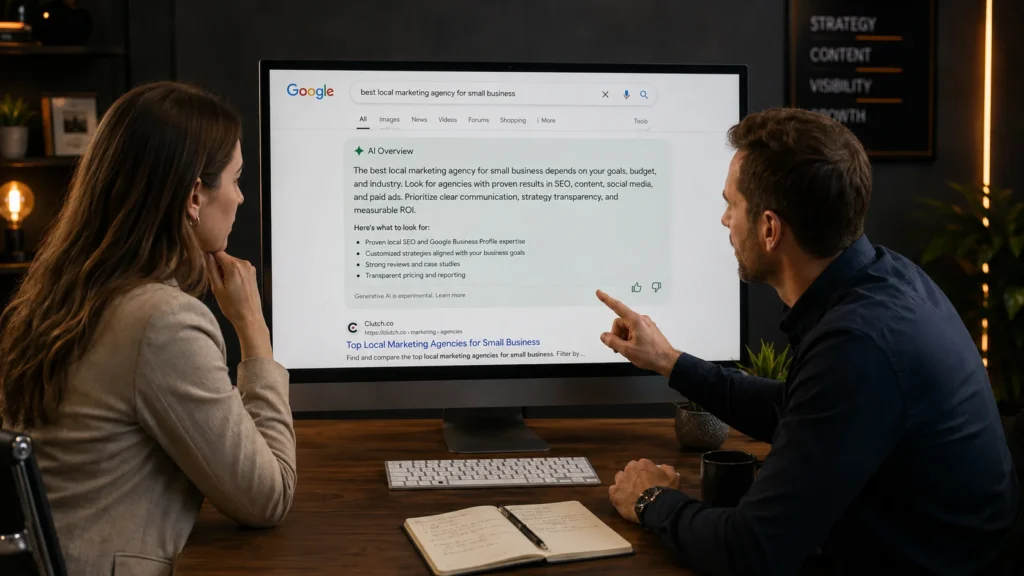
For years, SEO worked on a simple exchange. Someone searched, Google showed links, and a business tried to earn one of the clicks.
That exchange still exists. It just has more friction now.
Google rolled out AI Overviews in the U.S. in 2024 and said it expected the feature to reach more than a billion people by the end of that year, according to its announcement on generative AI in Search. OpenAI then pushed search inside ChatGPT, giving users answers with source links instead of always sending them back to a traditional results page, as explained in its ChatGPT Search announcement.
For a business owner, the change is easy to miss until it shows up in traffic.
Ranking still matters. Clicks still matter. But a customer can now compare options, read a summary, and narrow a decision before visiting a website. Sometimes the site still gets the click. Sometimes it only becomes one of the sources behind the answer.
That is where AI search and SEO now meet. Businesses have to think about traditional rankings, but also about whether their pages are credible enough to be cited, summarized, or used inside an AI-generated answer.
Search Is Becoming an Answer Layer
Traditional SEO was built around the website visit.
A user searched, saw a list of results, clicked, and then judged the business. That visit gave the company room to explain, persuade, collect a lead, or sell.
AI search adds an answer layer before that visit.
A user asking “best CRM for a small consulting firm” may get a short comparison before opening any result. Someone searching “how to choose a local dentist for a child” may see a summarized answer that already filters the decision. A founder asking what to put on a service business homepage may get a checklist without reading a full article.
The click has not disappeared. It is just less automatic.
SEO still depends on pages, authority, links, relevance, and technical health. The difference is that influence can begin before the visitor reaches the website. A business has to be clear enough for search engines to understand, useful enough for AI systems to reference, and credible enough for a person to trust once they do click.
A generic article can be summarized quickly.
A page with evidence, examples, expert input, original data, or clear decision-making detail gives both the search system and the reader more to work with.
The Zero-Click Problem Is No Longer Just About Snippets
Zero-click search is not new.
Google has answered weather, definitions, sports scores, and basic facts directly for years. Publishers and businesses have already dealt with featured snippets, knowledge panels, and answer boxes.
AI search makes the issue broader.
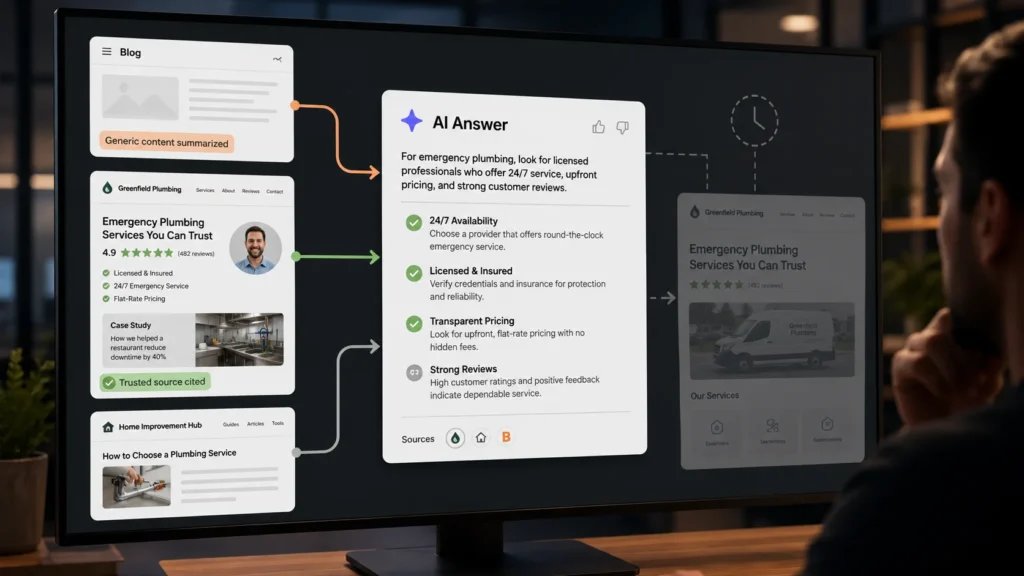
A featured snippet usually answered a narrow question. AI summaries can compare options, pull from multiple sources, and give the user enough context to delay or avoid a click.
Not every business feels that equally.
A local service provider may still get calls from high-intent searches. An ecommerce brand may still win traffic when users need product detail. Companies relying on broad educational content may feel the pressure sooner.
The easiest content to replace is the content that does not add much: generic definitions, rewritten beginner guides, and pages with no opinion, no proof, no author credibility, and no original insight.
Those pages may still get indexed. Some may still rank. But ranking is no longer the same as being chosen, cited, or visited in an AI-generated search experience.
That is the harder SEO challenge businesses are facing in 2026.
What Businesses Should Change First
The first reaction is usually to chase new labels.
GEO. AEO. AI SEO. Answer engine optimization.
Some of those frameworks are useful. Some are old SEO advice with a new name. The work that usually matters is less exciting.
Businesses need pages that are easy to understand, easy to trust, and easy to reference. Vague content does not help the reader much, and it does not give AI systems much substance either.
A service page that says “we provide quality solutions for modern businesses” gives the search engine almost nothing. A page that explains who the service is for, what problem it solves, what makes the provider credible, what process they follow, and what a customer should do next gives both humans and machines more context.
From the client audit observations I have seen across small and mid-sized business websites, the first gap is rarely one missing keyword. It is usually missing proof: thin service pages, weak author signals, no original examples, and content that sounds like it could belong to any company in the category.
Content and brand are starting to overlap more than many companies expected.
AI search is not only matching keywords. It is trying to understand entities, context, reputation, and whether a source deserves to be used in an answer. That pushes businesses toward clearer positioning, stronger service pages, consistent brand mentions, useful structured data, and content that says something specific.
Generic content can still be published.
It is just easier to ignore.
GEO Is Not a Replacement for SEO
Generative Engine Optimization sounds new, and part of it is. But the strongest version of GEO does not replace SEO. It builds on it.
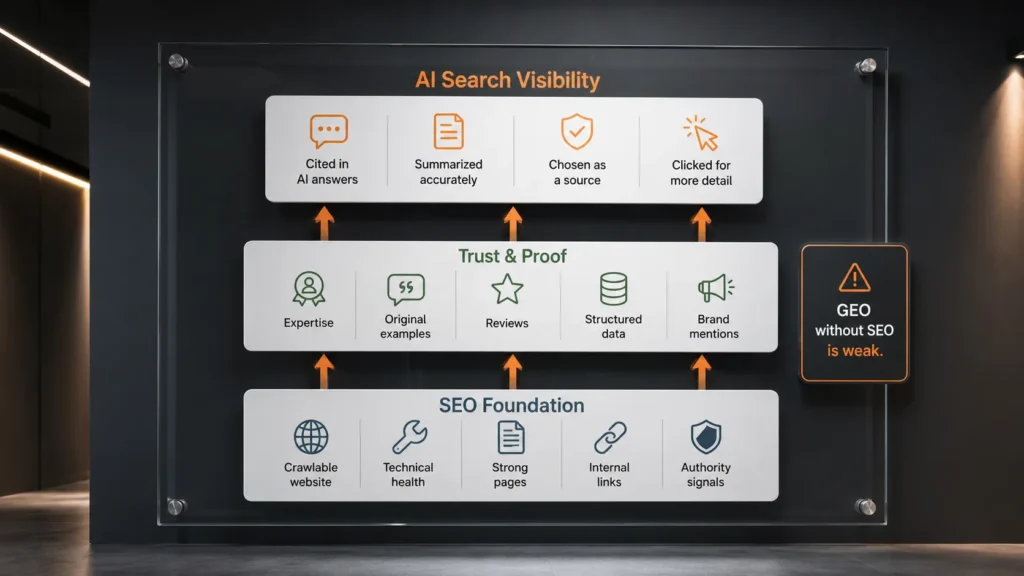
AI systems still rely on the open web, search indexes, structured pages, trusted sources, and clear information. If a business cannot be crawled, understood, or trusted in normal search, it is unlikely to become suddenly visible inside AI answers.
The standard is changing, though.
Old SEO often rewarded a page that matched the query well and had enough authority to compete. AI search adds another question: can this page help form a confident answer?
That changes the kind of content worth making.
A weak page covers a topic broadly. A stronger page helps someone make a decision.
A generic post on “best accounting software” can be summarized easily. A page comparing accounting software for small law firms, with selection criteria, limitations, pricing context, and expert commentary, has more reason to be cited.
The same pattern shows up in service businesses.
A basic “SEO services” page is easy to overlook. A page that explains the industries served, the audit process, technical checks, reporting standards, and what a business should expect in the first three months is more useful.
Users are not only typing keywords anymore. They are asking for judgment.
Search content has to meet that level of detail.
The Businesses Most at Risk
The companies most exposed are often the ones with replaceable content.
A site with hundreds of articles repeating the same beginner advice available everywhere else gives AI search plenty to absorb and little reason to send a user back. If there is no original data, no concrete example, no named expertise, and no clear brand authority, the page becomes easy to summarize and easy to skip.
Small and mid-sized businesses have another problem.
Many never built strong pages in the first place. They may have a homepage, a few short service pages, and a blog that exists because someone once said “SEO needs content.”
That setup was already weak before AI search. Now the weakness is more exposed.
The businesses that adapt will not always be the ones publishing the most. They will be the ones making their best pages more useful, more specific, and more credible.
That means fewer empty articles and more pages that answer buyer questions clearly.
What is included? Who is the service for? What makes the provider trustworthy? What does the process look like? What does the customer need to know before choosing?
Content like that still has a reason to exist.
Even when AI search summarizes part of the journey, businesses with stronger proof and clearer positioning have a better chance of being cited or clicked when the user wants more detail.
Where Search Goes Next
The wider impact of generative AI on business is already being debated across employment, wealth distribution, and entire industries. Search is only one part of that debate, but it touches almost every company that depends on visibility.
By 2027, many businesses may stop asking only, “Where do we rank?”
They may also ask, “Where are we being cited?”
A business might appear in a Google AI answer, a ChatGPT response, a Perplexity citation, a Gemini summary, a Reddit discussion, a review platform, or a comparison article before the customer ever reaches its website.
That makes the website more important, not less.
The site is still where the business controls the full story. Service pages, author profiles, case examples, original research, product details, pricing context, and trust signals all feed the wider search ecosystem. If those assets are weak, AI search has less reason to mention the business, and users have less reason to click when they do see it.
Companies that handle this well will not treat AI search as a separate trick.
They will clean up the basics first. Stronger service pages. Better proof. Clearer expertise. Original insight where they have it. Structured data where it helps. A brand people search for by name. A website that is fast, clear, and credible.
That is less exciting than chasing a new label like GEO.
It is also more likely to survive the next search update.
What Businesses Should Take Seriously Now
AI search will not replace SEO in one clean break. It is changing what good SEO needs to prove.
Businesses still need crawlable websites, strong pages, technical health, links, and content that matches intent. They also need evidence that they are worth being included in an answer.
That evidence can come from experience, original data, a clear point of view, reputation across the web, or a service page that answers buyer questions better than the generic articles around it.
The businesses that struggle most will be the ones treating content as space to fill.
The businesses that adapt will treat content as proof.
In the old search model, being found was the first battle. In AI search, being trusted enough to be summarized may become just as important.
That is the shift businesses need to prepare for in 2026.
FAQs
Is AI search replacing traditional SEO?
No. AI search is changing how SEO works, but it is not replacing the basics. Businesses still need crawlable websites, strong pages, technical health, useful content, and authority signals. The difference is that content now also needs to be clear and credible enough to be cited or summarized inside AI-generated answers.
What is GEO in SEO?
GEO stands for Generative Engine Optimization. It means improving content so generative AI systems can understand, trust, and reference it. GEO does not replace SEO. It builds on SEO by pushing businesses to create clearer pages, stronger proof, better entity signals, and more useful content.
Which businesses are most at risk from AI search?
Businesses that rely on generic, replaceable content are most at risk. Pages built around basic definitions, rewritten beginner guides, or thin service descriptions are easier for AI systems to summarize. Businesses with original examples, real expertise, strong service pages, and clear positioning have a better chance of being cited or clicked.
How should businesses prepare for AI search in 2026?
Businesses should improve their core pages first. That means stronger service pages, clearer expertise, original insights, better technical SEO, structured data where useful, and a website that gives both users and search systems enough proof to trust the business.